
Announcing Rstest 0.10
May 14, 2026



Rstest 0.10 has been released.
Notable changes:
- New
threadspool based onworker_threads - Run changed or related tests with
--changed/--related - Persistent build cache support
- Memory-aware worker spawn gate
- Support silent passed test consoles, even in concurrent runs
- Profile a run with
--trace - Clearer worker output attribution
A new threads pool
Rstest 0.10 now supports running tests in worker threads, which cuts cold-start time on suites with many small files.
Until this release, every test file ran in its own Node.js child process — the forks pool. child_process.fork is comparatively slow to start (worker_threads is roughly 10× faster), and each fork carries its own V8 heap, which can OOM under high parallelism.
The new threads pool is backed by node:worker_threads. Workers share the parent process's V8 heap and stdio, so spinning up many of them is both cheaper in wall time and lighter on memory.
To opt in, set pool to threads:
forks remains the default. Most existing test code relies on per-file process isolation, which threads do not provide. Switch to threads when your tests do not mutate process.chdir, environment variables, or signal handlers. Please refer to pool to learn more.
Run changed or related tests
Rstest 0.10 adds two flags that run only the tests affected by your source changes, shortening the inner-loop feedback time on a large suite.
--related treats positional arguments as source files and runs only the tests that depend on them. The dependency information comes from the build module graph, so the same filter works for Node mode and Browser Mode. --findRelatedTests is a Jest-compatible alias:
--changed applies the same approach but auto-detects the source files from your Git working tree. By default it includes unstaged, staged, and untracked files — your current uncommitted edits:
You can also pass a commit or branch to widen the range:
To preview which tests would run without executing them, combine either flag with rstest list:
Please refer to Run related tests and Run changed tests to learn more.
Persistent build cache
Rstest 0.10 supports persistent build caching for test runs, so repeated runs of the same project skip work that hasn't changed.
In an antd + three.js example project, enabling build cache approximately halves the build phase on warm runs:
Rspack's persistent cache is still experimental, so the cache is disabled by default. You can enable it explicitly:
Rstest applies a set of Rstest-aware defaults on top of Rsbuild's, so most projects do not need additional configuration. If you also use @rstest/adapter-rslib, the build cache settings from your Rslib config are passed through automatically. Please refer to performance.buildCache to learn more.
Memory-aware worker spawn gate
Rstest 0.10 now defers worker spawns when system memory or main-process heap headroom cannot safely host another worker, so high parallelism no longer pushes low-memory machines into OOM.
The gate matters most on CI containers and smaller dev machines, where the previous CPU-only scaling could exhaust system memory once worker RSS accumulated, or trip a V8 heap-limit crash in the host process. With the gate enabled, Rstest checks memory state before each new spawn and defers the next worker when launching it is not safe.
There is no public API or default-behavior change when memory is plentiful — the gate is invisible on machines that are not under memory pressure. If you need to disable it (for benchmarking, debugging, or hard-isolated environments), set the environment variable:
Support silent passed test consoles
Rstest 0.10 adds an opt-in silent option for intercepted test console output. Enable it when passing tests produce noisy debug logs while you still need to retain the logs that explain a failure.
Use silent: 'passed-only' to buffer console.* output while a task is running. If the file, suite, or test case passes, Rstest discards its buffered logs; if it fails, Rstest replays the matching logs with the failure output:
You can use the same behavior from the CLI:
For example, with this test file:
Only fail log will be printed.
This also works for concurrent tests. Rstest tracks the active file, suite, or test case before buffering a log, so a passing concurrent test can be silenced without hiding logs from a sibling that fails.
If you need a completely quiet run, set silent to true instead. Please refer to silent to learn more.
Profile a run with --trace
Rstest 0.10 adds a --trace CLI flag that breaks a run into per-phase, per-suite, and per-case slices and writes a Perfetto-compatible profile. Use it when the reporter's single Duration number is not enough to identify where the time is being spent:
The flag is CLI-only and opt-in. Each run produces per-phase slices per file (prepare → teardown), per-suite and per-case slices annotated with status and retry count, and a heap counter sampled at each phase boundary.
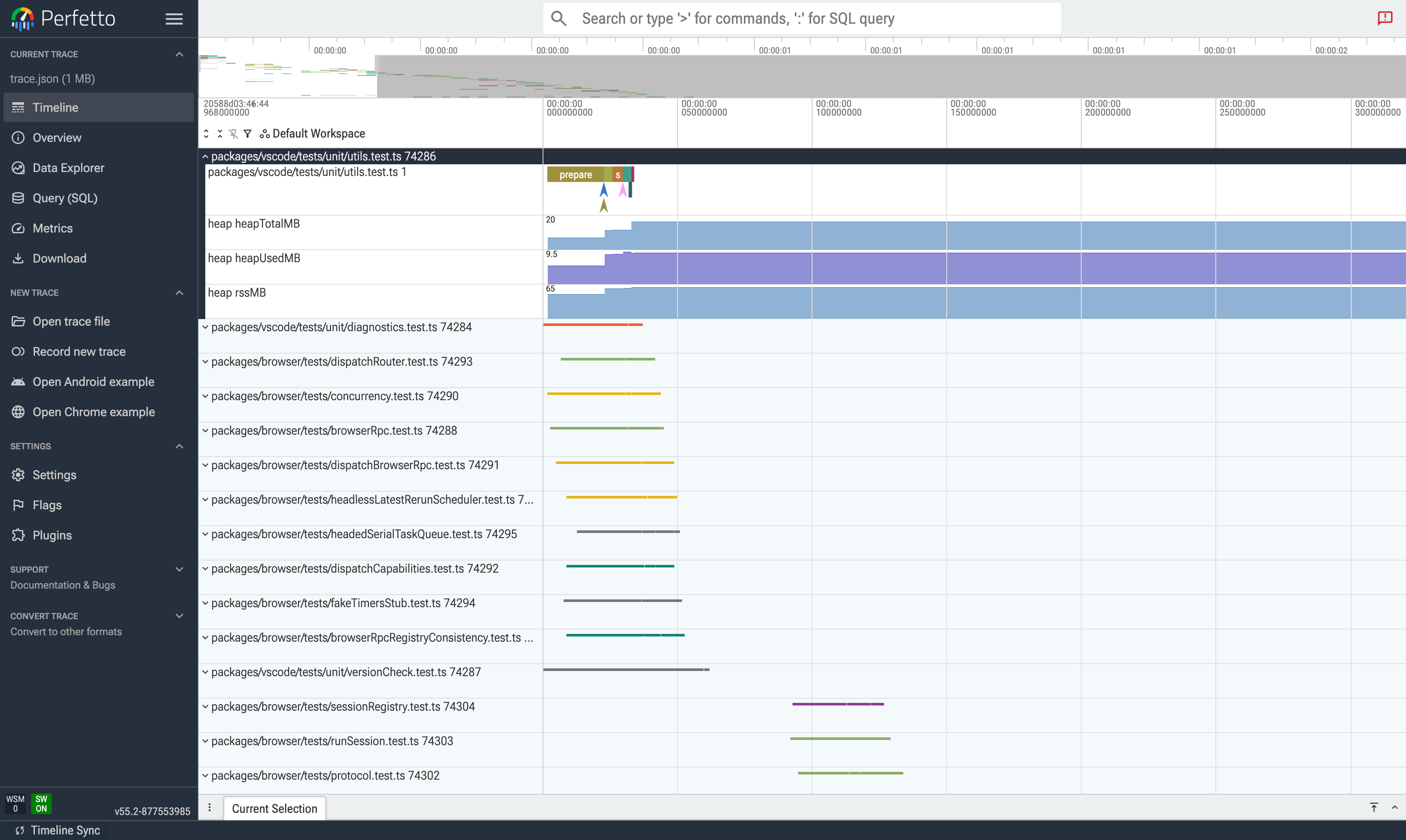
In a TTY, Rstest starts a local helper so that the printed link opens the trace directly in the Perfetto UI. In CI, the trace is written to <rootPath>/.rstest/trace-<ts>.json, which you can upload as an artifact.
For other profiling needs, such as CPU time distribution with samply, memory with --heap-prof, or step-through debugging with --inspect, please refer to the Profiler section.
Clearer worker output attribution
Rstest 0.10 reworks the worker pool internals so that worker output and crashes show up in the reporter with proper attribution. When a worker writes to stderr or fails, you now see:
- Per-task attribution. Output is routed through the reporter with the task identity that produced it, rather than arriving as untagged text mixed into the terminal.
- Structured crash signals. Worker crashes surface as a typed event carrying the failing task, rather than being inferred from raw stderr.
The reworked pool also creates workers on demand, so unused worker slots incur no startup or memory cost. This is what makes memory-aware spawn gating possible, and it is part of how the new threads pool is built.
For a full list of changes, see the v0.10.0 release notes.